

Getting laid off feels like the universe just kicked you in the teeth. But here's what the Entitleds don't want you to know: Getting laid off might be the best thing that ever happens to your career.
I know that sounds insane when you're staring at severance paperwork (or not, in some cases) and wondering how you'll pay rent. But hear me out: You're at a crossroads. You can spend the next six months sending out resumes and hoping someone else will give you a job. Or you can build something that no one can ever take away from you.
Let me show you how.
The Laid-Off Entrepreneur Advantage
Before we dive in, let's reframe what just happened:
What the corporate world sees: You lost your job What I see: You just got freed from spending 40+ hours a week making someone else rich
You probably have:
Severance pay (instant runway!)
Unemployment benefits (monthly income!)
Industry expertise (domain knowledge!)
Professional network (potential customers!)
Fresh motivation (nothing motivates like necessity!)
This is your moment. Don't waste it applying to jobs that frankly don’t exist.
The 10 Tips To Turn Laid-Off into Boss
Tip #1: Give Yourself Time to Feel Your Feelings, Then Get to Work
Look, losing a job sucks. It's okay to be angry, scared, or disappointed. Take some time to process.
Then? Stop it and get to work.
I don't say this to be harsh. I say this because action is the antidote to anxiety. You'll feel better the moment you start moving forward.
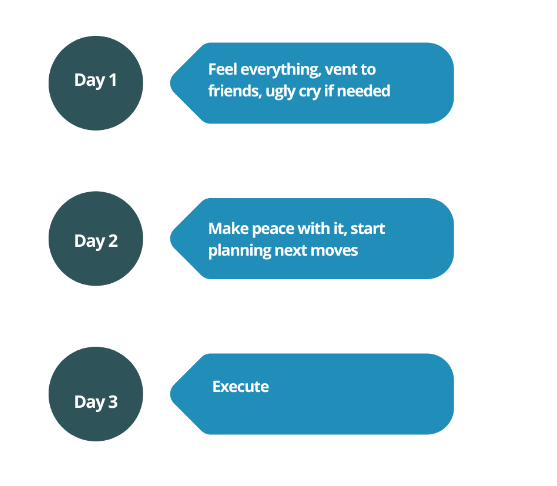
Your 48-hour plan:
Day 1: Feel everything, vent to friends, ugly cry if needed
Day 2: Make peace with it, start planning next moves
Day 3: Execute
Tip #2: Calculate Your Runway (And Don't Panic)
Before you do anything else, you need to know exactly how long you can go without income.
Add up:
Severance pay
Unemployment benefits (file TODAY if you haven't)
Emergency savings
Partner's income (if applicable)
Tax refunds
Any other liquid assets
Calculate your burn rate:
Required monthly expenses (rent, food, insurance, minimum payments)
Nice-to-have expenses (streaming services, gym, eating out)
Total monthly burn
Your runway = Total available money ÷ Monthly burn rate
Example: $15,000 severance + $2,000/month unemployment + $5,000 savings = $20,000 Monthly expenses = $3,500 Runway = 5.7 months
That's 5+ months to build something. That's enough.
Tip #3: Turn Your Old Job Into Your First Business Idea
The business idea you need might be hiding in the job you just lost.
Ask yourself:
What problems did I solve at my last job?
What processes did I streamline?
What did I know that others didn't?
What did clients/customers always complain about?
What did my company refuse to fix that drove everyone crazy?
Real examples:
Marcus: Laid off from corporate IT. Noticed companies struggle with cybersecurity basics. Started consulting business teaching SMBs cybersecurity fundamentals. First client in week 2, $8K month 1.
Jennifer: Laid off from marketing agency. Saw that small businesses needed help with social media but couldn't afford agencies. Started social media management service. Five clients at $500 each by month 3.
David: Laid off from HR role. Recognized companies needed help with remote work policies post-COVID. Created HR consulting niche. $120K year one.
Your expertise from your old job is gold. Don't waste it sending resumes. Monetize it.
Tip #4: Start as a Consultant While You Build Your Product
Here's a cheat code: Start generating income IMMEDIATELY by consulting while you develop your actual product.
Why this works:
Gets money flowing fast (week 1-2 instead of month 3-6)
Validates your idea with real customers
Builds case studies and testimonials
Funds your product development
Creates network for future product launch
The consulting-to-product playbook:
Weeks 1-2: Set up simple consulting offer
Define your expertise clearly
Set your rate ($100-200/hour minimum)
Create one-page offer
Reach out to 50 contacts
Weeks 3-8: Consult + build
Take on 2-3 consulting clients
Use consulting income to fund product development
Learn from client problems (product insights!)
Build MVP in parallel
Week 9+: Transition to product
Launch product to consulting clients first
Use case studies from consulting work
Keep 1-2 consulting clients for steady income
Scale product
This is exactly how I'd build if I were starting today. Fast income + validated product = sustainable business.
Tip #5: Use Your Laid-Off Status as Marketing Leverage
Don't hide that you got laid off. Use it.
Why it works:
People root for underdogs
"Laid off to boss" is a compelling story
Shows resilience and determination
Creates authentic connection
How to position it:
Don't say: "I got laid off and need clients" Do say: "After 10 years in [industry], I'm taking my expertise directly to clients who need it"
Don't say: "I'm desperate for work" Do say: "I'm selectively taking on 3-5 clients who want [specific outcome]"
On LinkedIn: "Update: After contributing to [company's achievements] for X years, I've been laid off. While unexpected, this is the push I needed to build something I've been dreaming about: [your business]. Currently helping [type of clients] achieve [specific result]. Taking on 3 new clients this quarter. Who should I talk to?"
Watch the responses roll in.
Tip #6: Leverage Every Relationship You Have
Your network is your net worth, especially when you're starting from scratch.
Make a list of everyone you know:
Former colleagues
Former clients/customers
Industry contacts
College friends
Family friends
Social media connections
Your dentist, your kid's teacher, everyone
For each person, ask:
Could they be a customer?
Do they know potential customers?
Do they have expertise you need?
Could they become a partner?
The outreach template:
"Hey [Name], Hope you're well! As you may have heard, I was recently laid off from [Company]. While unexpected, I'm excited to announce I'm starting [Your Business] to help [target customers] with [specific problem].
Given your work in [their field], I'd love to get your thoughts on [specific question].
Also, if you know anyone who might benefit from [your service], I'd appreciate an introduction.
Hope to catch up soon!"
Send 50 of these. You'll get 15-20 responses. 3-5 will turn into opportunities.
Tip #7: Cut Expenses Ruthlessly (But Strategically)
You need runway. That means cutting costs. But cut smart, not stupid.
Cut immediately:
Unused subscriptions (streaming, apps, memberships)
Eating out and delivery (meal prep instead)
Premium services (downgrade phone plan, etc.)
Non-essential shopping
Expensive habits (daily Starbucks = $150/month saved)
Don't cut:
Health insurance (get COBRA or marketplace plan)
Internet (you need this to build)
Phone (your business lifeline)
Basic mental health support
Anything that helps you build faster
Get creative:
Move in with family temporarily (not failure, strategy)
Take on part-time gig work (maintain runway while building)
Sell stuff you don't need
Negotiate with creditors (many have hardship programs)
The goal: Extend your runway from 6 months to 9-12 months. That's enough time to build something real.
Tip #8: Build Fast, Build Cheap, Build Smart
You don't have time or money to waste. Every dollar and day matters.
The $100 MVP rule:
Spend no more than $200 on your first version
Use free and low-cost AI tools like the free Builder Type quiz
Validate before you invest more
No perfection. Just progress.
Tip #9: Join Communities
You're not alone. Thousands of people get laid off every month. Many become entrepreneurs.
Find your people:
"Laid off" LinkedIn groups
Local entrepreneur meetups
Online founder communities
Industry-specific groups
buildthedamnthing.com community
Why community matters:
Emotional support when it's hard
Practical advice from those ahead of you
Accountability to keep going
Networking for customers and partners
Proof that this path works
Real talk: Building alone is brutal. Build with others who get it.
Tip #10: Give Yourself Permission to Win
This is the hardest part for Builders especially.
You might feel:
Guilty for not getting another "real job"
Worried about disappointing family
Scared of failing publicly
Uncertain if you deserve success
You were laid off. That "safe" job security was an illusion. The only real security is owning something no one can take from you.
Give yourself permission to:
Take this risk
Potentially fail
Ask for help
Succeed beyond your wildest dreams
Build wealth for your family
Never work for someone else again
The universe is conspiring for your greatness. Getting laid off was the push.
Now build the damn thing.
Real Laid-Off to Boss Stories
Robert Finney (my father): Displaced brewery worker → Taught himself to code → Senior Engineer at Microsoft. Built generational wealth for our family.
Sophia Amoruso: Laid off from multiple jobs → Started Nasty Gal → $100M business → Girlboss empire
Sarah Blakely: Laid off from sales job → Created Spanx prototype → Billionaire
You could be next.
Your 30-Day Laid-Off to Boss Action Plan
Days 1-2: Process emotions, then shift to action Days 3-7: Calculate runway, cut expenses, validate business idea Days 8-14: Set up consulting offer, reach out to network Days 15-21: Land first clients/customers Days 22-30: Build MVP, refine offering, plan scale
Resources for Laid-Off Entrepreneurs
Essential Tools:
File for unemployment IMMEDIATELY
Financial:
File for unemployment IMMEDIATELY
COBRA for health insurance (or Healthcare.gov)
SBA resources for small businesses
Local small business development centers (free consulting)
Support:
SCORE mentoring (free)
Local entrepreneur groups
Online founder communities
The Truth About Being Laid Off
Getting laid off feels like an ending.
It's actually a beginning.
The job you lost? It was making someone else rich while keeping you "safe."
The business you're about to build? It's going to make YOU rich while giving you real security.
Will it be scary? Yes. Will it be hard? Absolutely. Will it be worth it? Hell yes.
Getting laid off is hard. But you know what's harder? Spending the rest of your life wondering what you could have built.